

Today we are very excited to share an interview with author Sarah-SoonLing Blackburn!
Read on to learn more about the author, the book, and a giveaway!
Meet the Author: Sarah-SoonLing Blackburn

Dr. Sarah-SoonLing Blackburn is an educator, speaker and professional learning facilitator. She was born in Bangkok, Thailand into a mixed-race Malaysian Chinese and white American family. A classic “third culture kid,” she grew up moving between various East and Southeast Asian countries and the Washington DC area. Sarah moved to the Deep South in 2009, and she has now lived there longer than anywhere else. Her experiences first as a classroom teacher and then as a teacher educator inform her beliefs about the role that education can and must play in the realization of social justice.
She owes very much to her ancestors.
Sarah spent most of her years in the classroom teaching third and fourth grade. As a professional trainer, Sarah’s areas of focus have included workplace cultures, leadership skills, and diversity, equity and inclusion. Sarah has an M.A. in Social Justice and Education from University College London’s Institute of Education. Her doctoral research at Johns Hopkins University explored strategies for retaining rural educators, and her Ed.D. specialization was Instructional Design in Online Teaching and Learning. She is based out of Oxford, Mississippi.
About the Book: EXCLUSION AND THE CHINESE AMERICAN STORY
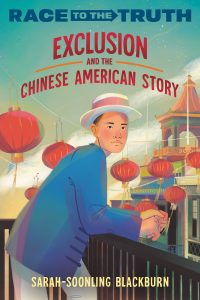
Until now, you’ve only heard one side of the story, but Chinese American history extends far beyond the railroads. Here’s the true story of America, from the Chinese American perspective.
A Junior Library Guild Gold Standard Selection
If you’ve learned about the history of Chinese people in America, it was probably about their work on the railroads in the 1800s. But more likely, you may not have learned about it at all. This may make it feel like Chinese immigration is a newer part of this country, but some scholars believe the first immigrant arrived from China 499 CE–one thousand years before Columbus did!
When immigration picked up in the mid-1800s, efforts to ban immigrants from China began swiftly. But hope, strength, and community allowed the Chinese population in America to flourish. From the gold rush and railroads to entrepreneurs, animators, and movie stars, this is the true story of the Chinese American experience.
~Author Chat~
YABC: What gave you the inspiration to write this book?
It’s hard to pick one reason! A big one is that I never got to read a book like this when I was a kid. I had two audiences in mind: First, I wanted to write a book for readers who identify as Chinese American, so they might see themselves, their families, and their histories reflected. I can’t even express what this would have meant to me as a young person. And I also wanted to write a book for readers who don’t identify as Chinese American, so that their concept of “Who is American?” can expand to more actively include us – not in a superficial way, but in a way that better includes the struggles, resilience, joys, and humanity of Chinese Americans.
YABC: What research did you do for the topic?
I had to do so much research. Like most Americans, I learned virtually none of this when I was in school. I was lucky that in the last few years there have been more books and articles published that specifically focus on Chinese and other Asian American stories, so that helped, but I will say that these groups are still underrepresented in the broader field of publishing. One of the hardest things was finding stories of individuals. I wanted to bring real people to life in the text so that readers could place themselves in moments in time in a more sensory way, and I wanted to spotlight names that they might never have heard before, but there aren’t a lot of great records available. And, to my deep regret, I never learned to read Chinese, so I had to rely on English-language sources. I have to say that I’ve gained a deep appreciation for newspaper archives and for state and local historical societies. These often included primary source documents, photographs, translations, and other materials that helped me learn more about individuals who appear in the text.
YABC: What scene in the book are you most proud of, and why?
I love the scenes that get you to think from the point of view of people who lived a long time ago. It makes the past feel a little less far away, and makes real the reverberations of history in the present. One that stands out is the Chinese railroad workers’ strike in 1867. I wanted readers to feel how difficult and dangerous the work was, so that they understood what was at stake, and to understand the tremendous courage and strategy the workers must have put into organizing to make lives just a little bit better.
YABC: If you could only write one genre for the rest of your life, what would it be and why?
The older I get, the more I love mysteries and noir. The best of these books are full of humanity, truth, and emotion, and they can also be very funny. I currently have zero experience writing in this genre, but I can have dreams, can’t I?
YABC: How do you keep your ‘voice’ true to the age category you are writing within?
I used to teach third and fourth grade, and I leaned hard into “Ms. Blackburn” mode for this book. I think it helped a lot that I already have a lived-in “voice” for this age group that I could slip into when writing. When I was wrestling with how to write about a big, complicated concept (I mean, how do you explain scientific racism to a 10-year-old?), I would visualize myself sitting across from one of my students. How would I break this down for them? That helped me with consistency and authenticity in the voice, but it also helped me to remember to include humor and wonder wherever I could.
YABC: What’s your least favorite word or expression and why?
I’m generally forgiving about bending and expanding the rules of language, but for some inexplicable reason I absolutely cannot stand it when I see “addicting” used as an adjective. This probably speaks to some character flaw deep within me.
YABC: What do you do when you procrastinate?
What don’t I do to procrastinate? My procrastination gets worse as I get closer to the finish line of a project. I think the perfectionist in me is unwilling to say “okay this is done,” because – as all writers know – there always seems to be more that can be done or improved. So you know that I am 95% through a project if my house is very clean, I’ve suddenly become a meal prepper, my inbox is newly organized… you get the idea. It’s not procrastination if it’s still “work,” right? My other real weakness is puzzles. I love jigsaw puzzles, crossword puzzles, colorful phone puzzles, whodunnit puzzles, pretty much anything that requires solving. Again, it’s not procrastination if your mind is still “working,” right?
YABC: What fandom would you write for if you had time?
I’m not sure if this counts as a fandom, but I love trains. There’s something so romantic and so tragic and so brutal about the rise (and, in many ways, the fall) of the railroads. But I also just love the way that people from various walks of life encounter one another as they cross a city or a vast landscape on a train. There should be entirely more books set on trains. I would write train historical fiction, train murder mysteries, train tragedies, train buddy comedies, train romances – pretty much any genre, but make it trains. This world needs more train content!
YABC: What’s up next for you?
I’m working on fiction at the moment (alas, with no trains in sight). It’s a different muscle, and one I haven’t worked in a while, but I’m really enjoying the process.
YABC: What is your favorite holiday or tradition and why?
Lunar New Year, definitely, which has so many traditions I love. Malaysian Chinese families, like mine, eat a dish called yee sang. You take a big platter and arrange all these colorful piles of ingredients on it – things like raw fish, shredded carrot and cucumber and radish, crushed peanuts, and fried wonton skins. A sauce is poured over the dish and everyone stands around it and mixes it all together while loudly saying their wishes for the new year. You want to use your chopsticks to lift it all high in the air as you mix, and the table ends up getting messy, but it’s a beautiful moment of communal celebration, and it’s delicious, too.
Title: EXCLUSION AND THE CHINESE AMERICAN STORY
Author: Sarah-SoonLing Blackburn
Release Date: 3/26/24
Publisher: Crown Books for Young Readers
ISBN-10: 0593567633
ISBN-13: 9780593567630
Genre: Nonfiction
Age Range: Ages 10 and up
*Giveaway Details*
Three (3) winners will receive a copy of EXCLUSION AND THE CHINESE AMERICAN STORY (Sarah-SoonLing Blackburn) ~ US Only!
*Click the Rafflecopter link below to enter the giveaway!*











What an important topic!
This would be a great addition to my MS library.
I like the cover and can’t wait to learn more about Chinese immigrants to the USA.
I’d love to read this one!